IP Camera and PoE Security Systems: The Complete Guide to Connecting Any Camera to AI Monitoring in 2026
You already have the cameras. Here's how to make them intelligent — connecting any IP or PoE security system to AI monitoring without replacing a single device.
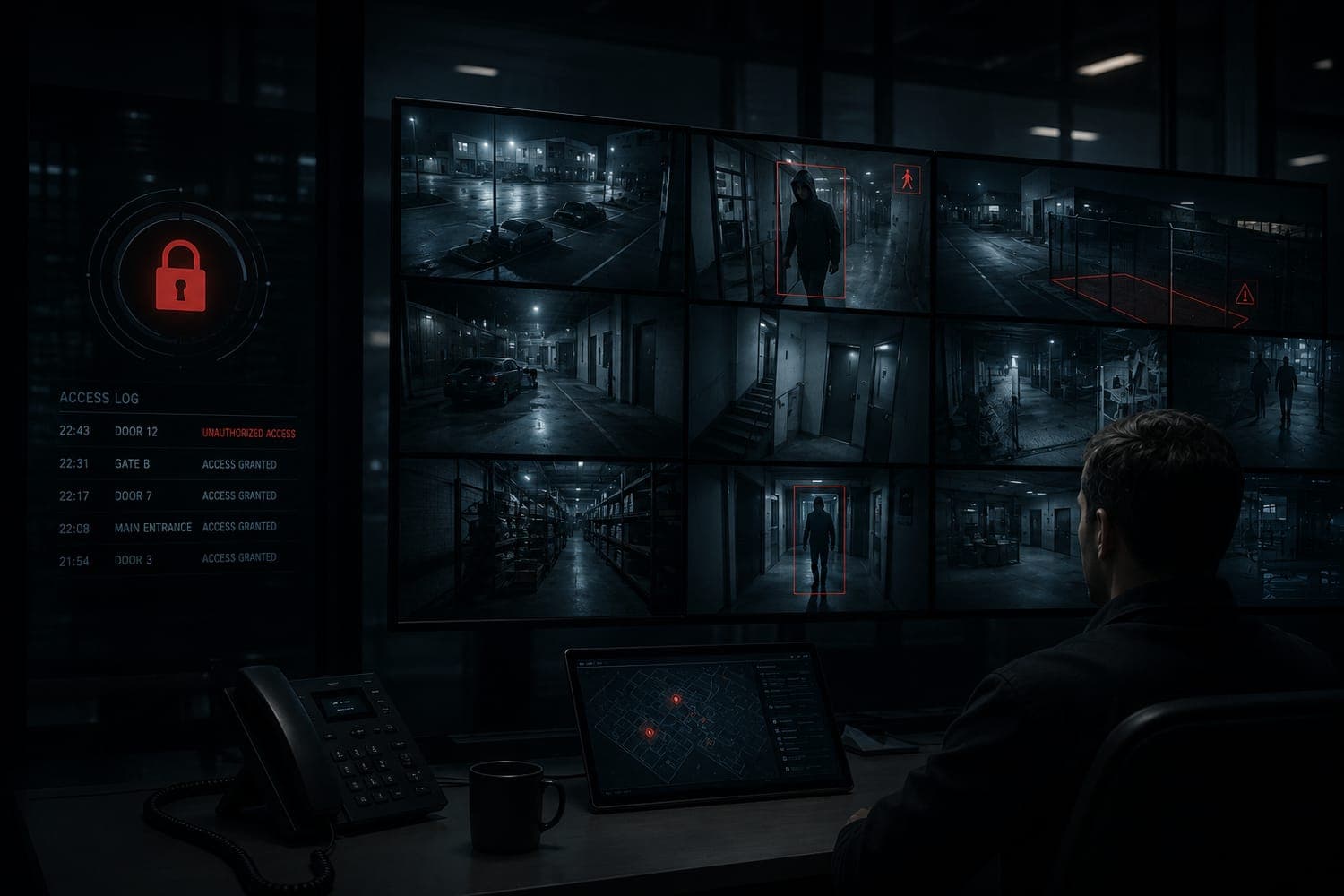
If your camera has an IP address and can stream video over a network, it can be connected to AI monitoring — no hardware replacement, no rip-and-replace. Modern platforms ingest video via RTSP and ONVIF, the universal protocols supported by virtually every IP camera from Hikvision, Dahua, Axis, Hanwha, Avigilon, Uniview, Bosch and others. Here's exactly how any IP camera or PoE security system connects to AI, brand by brand.
You probably already have the cameras. Here's how to make them actually intelligent — without replacing a single device.
The camera infrastructure you already have is more valuable than you think
There's a common misconception in the security industry: that getting AI-powered monitoring requires ripping out existing equipment and starting over with new proprietary hardware. It's what a lot of vendors would prefer you to believe, because it justifies a massive hardware sale.
The reality is different. Most security operations — residential buildings, commercial sites, industrial facilities, monitoring centers — already have functioning IP camera systems deployed. Hikvision, Dahua, Axis, Hanwha, Uniview, Bosch, Vivotek, CP Plus. Millions of cameras installed across the United States and Latin America, all generating continuous video streams, most of them barely being watched.
The question isn't whether you have cameras. The question is whether your cameras are working as hard as they could be. And for the vast majority of deployments — whether you're managing a warehouse complex in Texas, a residential tower in Bogotá, or a retail chain with locations across multiple countries — the answer is no. Because the intelligence layer simply wasn't there when the hardware was installed.
This is exactly the gap that modern AI monitoring platforms are designed to fill. If your camera has an IP address and can stream video over a network, it can be connected to AI. No hardware replacement. No ripping and replacing. Just software doing what hardware alone never could.
What actually makes a camera "AI-compatible"
IP connectivity is the only real requirement
Let's cut through the jargon. An IP security camera is simply a camera that transmits video data over a network — either wired ethernet, WiFi, or fiber — rather than over a traditional analog coaxial cable. That network connectivity is what makes everything else possible.
Two protocols do most of the work in modern IP camera systems:
RTSP (Real-Time Streaming Protocol) is the standard used to pull a live video stream from a camera to another system. If a camera can generate an RTSP URL — and virtually every modern IP camera can — that stream can be ingested, processed, and analyzed by an AI platform. It's the universal language of video streaming between devices.
ONVIF (Open Network Video Interface Forum) is the interoperability standard that lets cameras from different manufacturers communicate with video management systems using a common protocol. ONVIF compliance means a Dahua camera and a Hikvision camera can both be managed from the same platform without manufacturer-specific custom integrations. Almost every serious IP security camera sold in the last eight years is ONVIF-compliant.
If your cameras have RTSP streams and ONVIF support — and almost all current-generation IP camera systems do — you already have everything you need to connect to AI monitoring. Full stop.
What about PoE? Why it matters for security deployments
PoE security systems — Power over Ethernet — deserve a specific mention because they've become the dominant deployment architecture for professional-grade camera networks in both the US and Latin America, and for good reason.
In a PoE security system, the camera receives both its power supply and its network data connection through a single ethernet cable, eliminating the need for separate power runs to each camera location. For large deployments — a 50-camera office complex in Dallas, a residential building with cameras on every floor in Medellín, an industrial site with perimeter coverage in Los Angeles — PoE security systems reduce installation cost and complexity dramatically compared to traditional setups requiring dedicated power at each camera point.
From an AI integration standpoint, PoE security systems are ideal because they combine high-quality IP connectivity with centralized power management. A PoE switch or NVR becomes a natural aggregation point: all camera feeds flow through it, which is the same place an AI monitoring layer connects. The architecture is clean, the data is centralized, and the integration is straightforward.
The major IP camera brands — and how they all connect
One of the most common questions security operators ask is: "Does this work with the cameras I already have?" The short answer is yes, almost universally. Here's a breakdown of the major manufacturers and what their integration looks like in practice — across both the US and Latin American markets.
Hikvision
Hikvision is the world's largest camera manufacturer by volume and one of the most widely deployed brands across both Latin America and the United States. Their cameras support RTSP and ONVIF natively, and Hikvision also offers a proprietary API (ISAPI and ISUP) that enables deeper integration beyond basic video streaming — including event triggers, device status, and two-way audio. For AI monitoring platforms, Hikvision cameras are among the most straightforward to integrate, partly because of how ubiquitous they are and how well-documented the protocols are.
Dahua
Dahua is the second-largest global camera manufacturer and extremely common in both LATAM and US deployments, particularly in residential and commercial security. Like Hikvision, Dahua supports both RTSP streams and ONVIF, plus a proprietary SDK for deeper integration. Dahua's NVR ecosystem is particularly widespread — monitoring centers in Colombia, Peru, Mexico, and across the southern United States manage large Dahua NVR installations as their primary recording infrastructure.
Axis Communications
Axis is the premium tier of IP security camera manufacturing — widely used in high-security environments, government installations, and enterprise deployments across North America and Latin America. Axis cameras are fully ONVIF-compliant and offer RTSP streaming, plus their own VAPIX API for advanced integration. Axis also has a native analytics framework (AXIS Camera Application Platform), which means AI platforms can either integrate at the stream level or, in some cases, at the application level directly on the device. In the US, Axis is particularly common in healthcare, education, and critical infrastructure.
Hanwha Vision (formerly Samsung Techwin)
Hanwha has a strong presence in both the US and Latin American markets, particularly in retail and banking verticals. Their cameras support standard RTSP and ONVIF protocols, and Hanwha NVR systems are widely deployed in mid-to-large commercial sites. In the United States, Hanwha has grown significantly as an alternative to Chinese-manufactured cameras for operators subject to federal procurement restrictions (NDAA compliance).
Uniview (UNV)
Uniview has grown rapidly in the Latin American market over the last five years, partly because of competitive pricing and solid hardware quality at the mid-market tier. Full ONVIF and RTSP support makes them straightforward to integrate into any AI monitoring stack.
Bosch Security Systems
Bosch occupies the enterprise and industrial tier on both sides of the market — common in manufacturing, logistics, and critical infrastructure in the US, Germany, and across Latin America. Their cameras support ONVIF and RTSP, plus a proprietary integration layer (Bosch Video SDK) for deeper functionality. In practice, AI platforms connect to Bosch cameras via the same RTSP/ONVIF path as any other manufacturer.
Avigilon (Motorola Solutions)
Avigilon is worth a specific mention for the US market, where it's one of the most commonly deployed enterprise-grade IP security camera brands — particularly in large commercial real estate, hospitality, and campus security. Avigilon cameras support ONVIF and RTSP, making them compatible with external AI monitoring platforms despite Avigilon's own integrated analytics suite.
Other brands: CP Plus, Vivotek, Reolink, and beyond
The list goes further — CP Plus, Vivotek, Reolink, Amcrest, Tiandy, and dozens of others. The common thread is IP connectivity. If the device can generate an RTSP stream, it can feed an AI monitoring system. The specific brand is far less important than whether the camera is on a network.
NVRs and DVRs: you don't need individual camera access to get started
Here's a point that surprises many security operators: you don't necessarily need direct access to each individual camera. If your cameras feed into an NVR (Network Video Recorder) or a DVR (Digital Video Recorder) with IP output, the AI monitoring layer can connect at that level instead.
An NVR aggregates streams from multiple IP camera systems and provides centralized access — typically via RTSP or ONVIF. An AI platform that connects to the NVR effectively gets access to every camera feed managed by that recorder without needing individual camera connections. This is particularly useful for PoE security systems where the PoE NVR is already the central point of the network.
DVRs are slightly different — they traditionally handle analog cameras — but most modern DVRs are hybrid units that convert analog signals to digital and expose IP outputs. If the DVR has network connectivity and an RTSP stream, it connects to AI monitoring the same way an NVR does.
This NVR/DVR integration path is critical for scaling. A monitoring center in the US or Latin America managing 50 client sites doesn't need 2,000 individual camera connections — they need 50 NVR connections, each of which provides access to the full camera fleet at that site.
A note on US market considerations: NDAA compliance
For security operators working with US federal agencies, government contractors, or institutions subject to federal procurement rules, there's an additional layer worth understanding: NDAA (National Defense Authorization Act) compliance.
Certain camera manufacturers — most notably Hikvision and Dahua — have been restricted from federal government procurement under Section 889 of the NDAA due to national security concerns. This doesn't affect their use in private commercial deployments, but operators serving US federal clients or working in regulated environments need to be aware of it.
For those contexts, NDAA-compliant alternatives include Axis, Hanwha Vision, Avigilon, Bosch, and a growing list of US-based or allied-nation manufacturers. All of these support the same RTSP and ONVIF protocols — so from an AI monitoring integration standpoint, the switch from a restricted brand to an NDAA-compliant one is transparent. The integration path is identical.
How Closely connects to any IP camera infrastructure
Closely is built around one foundational principle: security operators shouldn't have to replace their existing infrastructure to get AI monitoring. The platform connects to any camera, NVR, or DVR that has IP connectivity — which in practice means any modern deployment using Hikvision, Dahua, Axis, Hanwha, Avigilon, Uniview, Bosch, or any other manufacturer supporting RTSP and ONVIF.
The integration works at the stream level. Closely ingests the RTSP feed from each camera or NVR, runs it through a three-tier detection pipeline — motion filtering, computer vision object detection, and AI behavioral reasoning — and surfaces validated alerts to SOC operators. The camera doesn't need to know Closely exists. The NVR doesn't need to be reconfigured. The existing VMS or monitoring software doesn't get replaced. Closely sits on top as an intelligence layer, not as a replacement for the infrastructure beneath it.
For a security company managing a mixed fleet of Axis cameras at US enterprise clients alongside Hikvision and Dahua at Latin American residential sites, Closely works the same way across all of them. The AI layer is infrastructure-agnostic — what matters is the IP connection, not the brand on the camera housing.
Beyond real-time detection, every event processed by Closely generates structured incident data — timestamped, classified, and linked to visual evidence. That data accumulates across your entire camera fleet, creating an operational intelligence layer with value beyond the individual alert: for performance reporting, client SLA management, audit trails, and institutional use cases like risk scoring and insurance underwriting.
If you want to see how Closely connects with your specific camera infrastructure — whether it's an Avigilon deployment in the US, a mixed Hikvision/Dahua NVR setup across Latin American sites, or a PoE security system spanning multiple countries — the team is available to walk through your setup and confirm compatibility before any commitment.
Frequently Asked Questions
What is the difference between an IP security camera and a traditional analog CCTV camera?
An IP security camera transmits video data over a network (ethernet or WiFi) as digital data. A traditional analog camera transmits a video signal over a coaxial cable to a DVR. The practical differences are significant: IP camera systems offer higher resolution, remote accessibility, two-way communication, and most importantly, the ability to connect to AI monitoring platforms via standard protocols like RTSP and ONVIF. Analog cameras require conversion hardware to access these capabilities.
What is PoE and why do most professional security installations use PoE security systems?
PoE stands for Power over Ethernet. In a PoE security system, each camera receives both its power supply and its data connection through a single standard ethernet cable — eliminating the need for separate power wiring at each camera location. For professional deployments in the US and Latin America, this simplifies installation significantly and reduces cost. A PoE switch or NVR powers and connects all cameras from a central point, which also makes it the natural integration point for AI monitoring.
Can AI monitoring platforms connect to Hikvision and Dahua cameras without replacing them?
Yes — and this is one of the most important things to understand. Both Hikvision and Dahua cameras support RTSP streaming and ONVIF, which are the standard protocols AI monitoring platforms use to ingest video feeds. Platforms like Closely connect directly to existing Hikvision and Dahua installations — including through their NVRs — without any hardware changes. Your current IP camera systems continue working exactly as before; the AI layer processes the streams on top.
What is RTSP and why does it matter for IP camera integration?
RTSP (Real-Time Streaming Protocol) is the standard protocol that IP security cameras use to make their video stream accessible to other systems. Think of it as the camera's way of saying "here's my live feed, come get it." Every AI monitoring platform that works with cameras — including Closely — uses RTSP to ingest video streams. If your camera can generate an RTSP URL, it can connect to AI monitoring. Virtually every modern IP camera manufactured in the last eight years supports RTSP.
What is ONVIF and which camera brands support it?
ONVIF is an industry standard that ensures cameras from different manufacturers can communicate with the same software platforms. It's what allows a Dahua camera and a Hanwha camera to both be managed from a single system without custom integrations for each brand. Hikvision, Dahua, Axis, Hanwha, Avigilon, Uniview, Bosch, Vivotek, and virtually every other serious IP security camera manufacturer has supported ONVIF for years. If your cameras are ONVIF-compliant, they're compatible with AI monitoring platforms that use the same standard.
Are Hikvision and Dahua cameras allowed in the United States?
Hikvision and Dahua cameras are legal for private commercial use in the United States. The restriction under NDAA Section 889 applies specifically to federal government procurement and federal contractors — not to private businesses, residential operators, or commercial security companies. That said, operators serving US federal clients or working in regulated sectors should verify their specific compliance requirements and consider NDAA-compliant alternatives like Axis, Hanwha, or Avigilon.
Can AI monitoring connect to a DVR or NVR instead of individual cameras directly?
Yes, and for large deployments this is often the preferred approach. An NVR aggregating feeds from a PoE security system already provides centralized access to all those cameras via RTSP or ONVIF. An AI platform connecting at the NVR level gets access to every camera managed by that recorder — making it practical to integrate an entire site's camera network through a single connection point rather than managing hundreds of individual camera URLs.
Does connecting cameras to an AI monitoring platform slow down or affect the existing recording setup?
No. The AI monitoring layer connects to the camera's RTSP stream as a separate consumer — it doesn't interrupt or interfere with the existing recording workflow. The NVR or DVR continues recording exactly as before. The AI platform processes its own copy of the stream independently. From the camera's perspective, it's simply sending its video to one more destination.
What's the minimum camera quality needed for AI video analytics to work reliably?
Meaningful AI detection typically requires at least 1080p (Full HD) resolution at a reasonable frame rate — 10fps minimum, though 15-25fps is preferred for behavioral analysis. Most IP security cameras manufactured in the last five years meet or exceed this. Critically, positioning and coverage angle matter as much as resolution: a well-positioned 2MP camera will outperform a poorly positioned 8MP camera for detection purposes. Lighting conditions and lens quality also factor in, which is why camera placement review is typically part of any AI monitoring deployment.
How do I know if my existing IP camera system is compatible with Closely?
The compatibility check is straightforward: if your cameras, NVR, or DVR have IP connectivity and support RTSP streams or ONVIF — which covers essentially all current-generation equipment from Hikvision, Dahua, Axis, Hanwha, Avigilon, Uniview, Bosch, and most other major brands — they're compatible. The Closely team can confirm compatibility for your specific setup and walk through the integration path before any pilot commitment. In the vast majority of cases, no hardware changes are needed at all.