Surveillance and CCTV Technologies: What's Actually Working in 2026 (and What's Not)
A practical breakdown of how CCTV surveillance systems, AI video surveillance, and video analytics software are changing security operations — and what to look for.
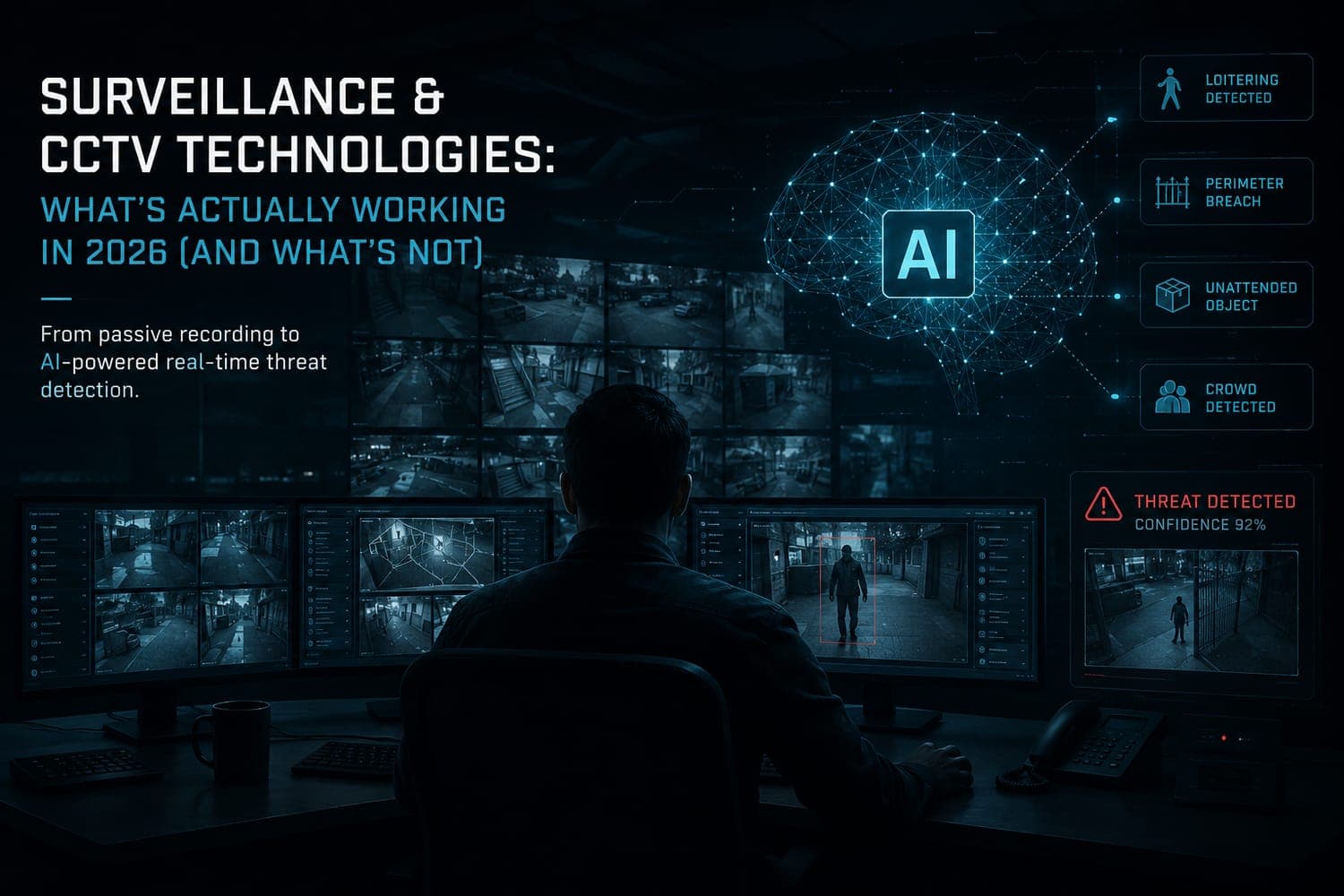
Traditional CCTV surveillance systems are essentially expensive hard drives — they record footage but depend on a human watching the screen to catch anything. The shift happening in 2026 is from passive recording to active, intelligent monitoring: AI video surveillance that watches every feed simultaneously, detects specific behaviors in real time, and only escalates what actually matters. Here's what's working, what's not, and how to evaluate it.
If you run a security operation and you still think surveillance is just about recording footage — this is worth five minutes of your time.
The real problem with most CCTV surveillance systems today
Let's be honest about something most vendors won't say out loud: a lot of CCTV surveillance systems deployed today are essentially expensive hard drives. Cameras everywhere, footage recorded 24/7, and operators staring at screens hoping to catch something before it's too late.
That model has a fundamental flaw. A human being can realistically monitor around 6 to 8 camera feeds with real attention at any given time. The average security camera monitoring setup in a mid-sized operation has 30, 50, sometimes over 100 feeds running simultaneously. You do the math — most of what's happening on those screens is never actually watched by anyone until after an incident occurs.
And that's the core issue. CCTV surveillance systems were designed around the idea of having a record, not around preventing something from happening. The footage exists. But by the time someone reviews it, the moment has passed.
This is what's driving a major shift in the surveillance and CCTV industry right now: the move from passive recording toward active, intelligent monitoring.
How surveillance technology has actually evolved
From analog cameras to AI-powered intelligence
The evolution of surveillance and CCTV technologies isn't just a hardware story — it's a data story.
The first generation was analog: grainy footage, VHS tapes, maybe a monitor at a guard desk. The second generation went digital: IP cameras, network video recorders, remote access. Both generations improved the quality of what you could capture, but neither solved the fundamental problem of who's actually watching it and what they do with it.
The third generation — where we are now — is about AI video surveillance: systems that don't just record, but understand what they're seeing.
Modern AI video surveillance platforms use computer vision models trained on millions of real security events. They can watch every feed simultaneously, identify specific behavioral patterns, and flag anomalies in real time — without needing a human to be staring at the screen every second. Loitering near a restricted area, an unattended package left in a corridor, someone crossing a virtual perimeter line at 2am — these are the kinds of patterns AI video surveillance catches reliably and fast.
The difference between a system that records and a system that understands is enormous when you're trying to prevent incidents rather than document them.
What video analytics software actually does (without the marketing fluff)
Here's where a lot of people get confused, because the term gets used loosely. Video analytics software isn't magic — it's a set of algorithms trained to detect specific events or conditions within a video stream.
Good video analytics software typically does some combination of the following:
Object detection — identifying people, vehicles, objects within the frame. This is the foundation. If the system can't reliably separate a person from a tree branch in the wind, everything built on top of it breaks down.
Behavioral analysis — understanding what detected objects are doing, not just that they exist. A person walking through a lobby is normal. A person pacing the same 10-meter stretch for 45 minutes is not. The difference is behavior, and video analytics software that operates at this layer is where you start getting real operational value.
Event classification — taking a detected behavioral pattern and assigning it a category: loitering, perimeter breach, crowd formation, vehicle obstruction, open door in a restricted zone. This is what drives alert generation.
Confidence scoring — assigning a probability to each detection. Not every movement near a fence line is a breach attempt. Good video analytics software tells you how confident it is, which lets the system filter noise and only escalate when confidence exceeds a defined threshold.
The gap between basic video analytics software and advanced platforms is almost entirely in that last point — confidence scoring and false positive management. More on that in a moment.
The false positive problem is bigger than people admit
If you've worked in security camera monitoring, you know this one well. False alarms are the silent killer of every surveillance operation.
An operator who gets 200 alerts per shift, 180 of which turn out to be nothing — a car entering a parking lot, a shadow moving, a branch in front of a lens — stops trusting the system. Alert fatigue is real and measurable. When everything is flagged as urgent, nothing is treated as urgent.
This is where the architecture of the detection system matters enormously. The best CCTV surveillance systems today use a layered detection approach rather than a single model:
- Native NVR triggers — basic motion detection that filters out static noise
- Computer vision analysis — a model like YOLOv8 that validates whether the motion involves a relevant object (person, vehicle, etc.)
- AI reasoning — a higher-order model that handles ambiguous cases, asking what is actually happening here and does it warrant escalation?
Running every pixel through the top-level AI model is expensive and slow. Running the final reasoning layer only on cases that passed the first two filters keeps the system fast, cost-efficient, and accurate. It's the approach that makes real-time threat detection operationally viable at scale.
Real-time threat detection: what it means in practice
"Real-time threat detection" is one of those phrases that gets thrown around in every security pitch deck. So let's break down what it actually means operationally.
Real-time doesn't mean instantaneous — it means within a window that allows a meaningful human response. For most security camera monitoring scenarios, that window is somewhere between 10 and 60 seconds from event onset to alert reaching an operator.
Threat detection means more than just spotting a person in a frame. It means classifying whether what's happening represents a deviation from the expected pattern at that location, at that time of day, given the context of that site.
A delivery driver entering a warehouse at 9am is normal. The same behavior at 3am on a Sunday is a detection event. Real-time threat detection systems that work understand context — location, schedule, access permissions, historical baseline — not just what's visible in a single frame.
The practical outcome of genuine real-time threat detection is a shift from reactive to proactive security camera monitoring. Instead of reviewing footage after something happened, operators receive prioritized alerts while something is developing, giving them time to assess, verify, and respond before the situation escalates.
Where AI video surveillance is heading
The trajectory is clear. A recent global security report found that AI video surveillance and analytics ranked as the single most important cutting-edge technology for security decision-makers worldwide — with 45% of chief security officers citing it as their top investment priority for the next two years. In Latin America, that number climbs to 46%, above the global average, driven by higher levels of physical insecurity and increasing camera density across the region.
The next evolution of AI video surveillance isn't just better cameras or faster models. It's the shift from detecting individual events to generating structured intelligence across networks of sites.
When a CCTV surveillance system can correlate incidents across 50 buildings operated by the same security company — tracking incident types by time of day, location, severity, and response time — you stop managing alerts and start managing patterns. That's the difference between operational data and genuine security intelligence.
This is also where the value for insurers, logistics companies, real estate operators, and governments starts to become obvious. The incident data that a mature AI video surveillance network generates isn't just operationally useful — it's a risk data layer that has never existed before in most markets.
How Closely is rethinking surveillance for security operators
Most AI video surveillance platforms sell to individual sites — one building, one client, one set of cameras. The problem with that model is that it ignores how security companies actually operate: managing hundreds or thousands of cameras across dozens of clients from a centralized SOC.
Closely is built around that reality. Rather than a site-by-site tool, Closely sits as an AI layer above the existing CCTV surveillance systems security operators already have deployed — Dahua, Hikvision, Milestone, and others — without requiring hardware replacement.
The platform runs what it calls Watchers: configurable detection agents that monitor specific behaviors across camera feeds. Loitering detection, virtual perimeter lines, open door alerts, crowd accumulation — each Watcher can be set up and tuned to the specific risk profile of each client site.
The intelligence generated by those Watchers feeds into a centralized security camera monitoring interface that lets SOC operators manage alerts across their entire client portfolio from one place. Alerts are pre-validated and classified before they reach the operator — so instead of 200 raw triggers per shift, operators receive 15 to 20 genuinely relevant events that need human judgment.
What Closely also does — and this is the part that matters for the longer game — is convert every validated incident into structured data. Timestamp, location, incident type, confidence score, response taken, time to resolution. That metadata, aggregated across a network of operators and thousands of sites, becomes something no single security company could build on their own: a real-time threat detection and risk intelligence layer that has real commercial value beyond the immediate operational application.
If you run a security company or monitoring center and want to see what this looks like in practice, the Closely team is running active pilots right now with security operators across Latin America.
Frequently Asked Questions
What is the difference between CCTV surveillance systems and AI video surveillance?
Traditional CCTV surveillance systems record and store footage passively — they depend on a human watching the screen to catch an incident. AI video surveillance systems actively analyze the video feed in real time, detect specific events or behaviors, and alert operators automatically. The core difference is passive recording vs. active intelligence.
How does video analytics software reduce false alarms in security operations?
Good video analytics software uses layered detection: basic motion filtering first, then object classification (is this a person or a shadow?), then behavioral analysis (is this person behaving abnormally?), and finally a confidence score. Only detections that pass all layers with sufficient confidence generate an alert. This cascade approach cuts false alarms dramatically compared to single-model detection.
Can AI video surveillance work with the cameras I already have installed?
In most cases, yes. Modern AI video surveillance platforms are designed to integrate with existing IP cameras from major manufacturers like Dahua, Hikvision, Axis, and others via standard protocols like RTSP and ONVIF. You typically don't need to replace hardware — you add the AI layer on top.
What does real-time threat detection actually mean for a security operator?
Real-time threat detection means that when an anomaly occurs — someone crossing a perimeter line, loitering near a restricted zone, a vehicle stopping in a no-parking area — the system identifies it within seconds and sends a validated alert to the operator. The operator can then verify and respond while the situation is still developing, rather than reviewing footage afterward.
How many cameras can one operator realistically monitor without AI assistance?
Research and operational benchmarks consistently show that a human operator maintains effective attention on roughly 6 to 8 live camera feeds. Beyond that, attention degrades and incidents get missed. AI-assisted security camera monitoring platforms can monitor thousands of feeds simultaneously and only surface the events that require human judgment.
What types of events can video analytics software detect?
Common detection capabilities in mature video analytics software include: loitering (person stationary in a zone beyond a time threshold), perimeter breach (crossing a defined virtual line), tailgating (unauthorized person following through an access point), crowd formation, unattended objects, vehicle intrusion, and door/gate status monitoring. More advanced platforms can handle custom behavioral rules.
How is AI video surveillance different from just having more security guards?
Guards provide presence and physical response capability — AI doesn't replace that. AI video surveillance extends what guards and monitoring operators can observe. A guard can physically be in one place; an AI system watches every camera simultaneously. The combination — AI for detection, humans for judgment and response — outperforms either alone.
Is AI-powered CCTV surveillance expensive to implement?
The cost structure has shifted significantly. Because modern AI video surveillance platforms run as software on top of existing camera infrastructure, the incremental investment is mostly software licensing — not hardware replacement. For security companies managing hundreds of cameras, the ROI calculation typically compares software cost against the labor cost of additional human operators, which usually makes the AI layer very cost-effective.
What data does a CCTV surveillance system generate and who can use it?
Every validated incident from a CCTV surveillance system can be structured as data: timestamp, location, incident type, severity, response time, outcome. At scale, this data is valuable not just for the security operator's own operations, but for insurers (risk underwriting), real estate companies (property risk scoring), logistics operators (route and delivery safety), and governments (public safety planning).
How do I know if my security operation is ready for AI video surveillance?
A few signals that the time is right: your operators are managing more cameras than they can realistically monitor, you're getting a high volume of false alarms that's causing alert fatigue, you want to offer clients better SLAs without proportionally increasing headcount, or you're looking to differentiate your service offering. If any of those fit, AI video surveillance is worth evaluating seriously — and a pilot with a platform like Closely is a low-commitment way to test it against your actual operations.