A Safer Colombia under De la Espriella: What's Coming for Citizens and Security Companies
The new government puts security at the center. What changes for citizens and what opportunities open up for private security companies in Colombia.
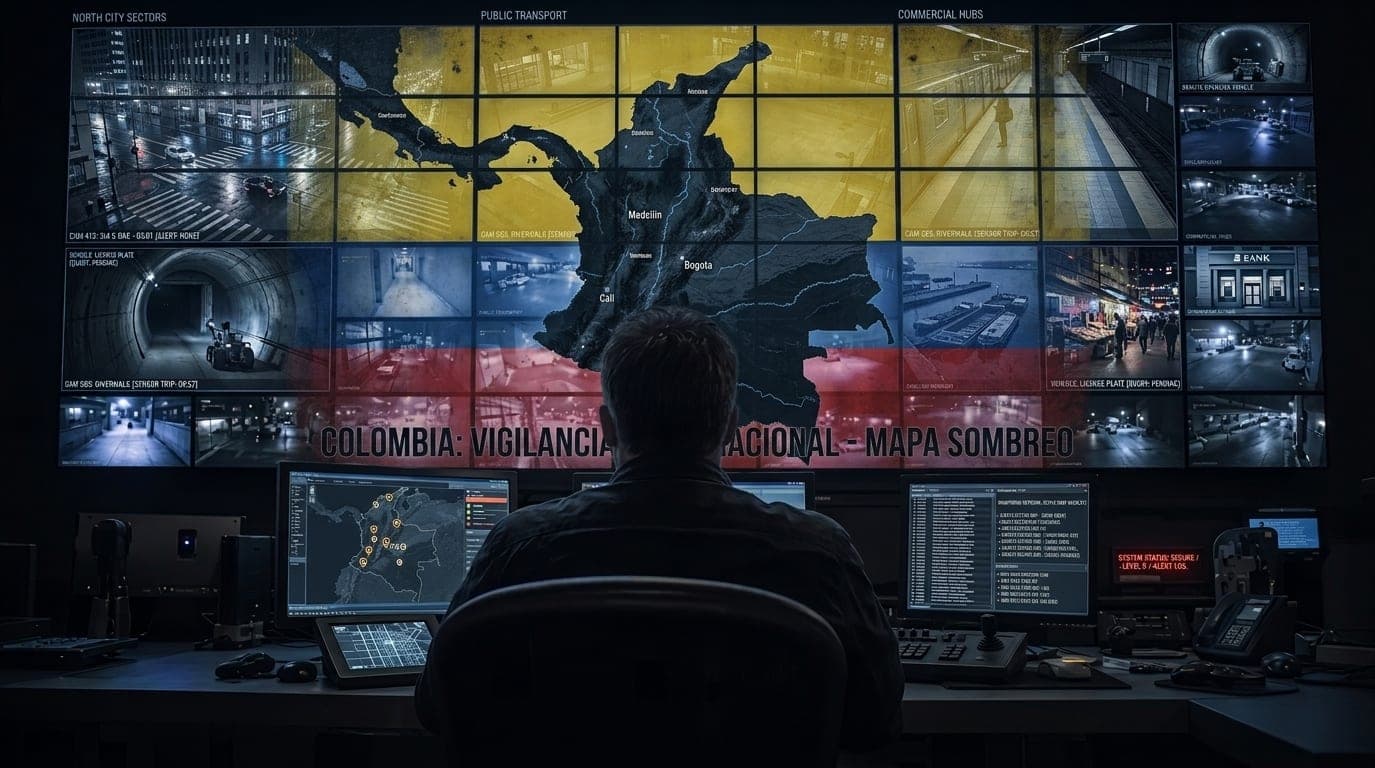
Colombia's new government puts security at the center of its entire plan, with concrete commitments: regain territorial control in 90 days, create a special task force against extortion, and equip law enforcement with cutting-edge technology. For private security companies in Colombia, this opens the biggest growth cycle in decades — and artificial intelligence applied to physical security is the ingredient that makes it possible.
On Monday, June 22, Colombia woke up different. Abelardo de la Espriella won the presidency with a clear, no-nonsense pitch: this country is done playing games with crime. And if you look closely at his government plan, the first thing that stands out is that security in Colombia isn't just one issue among thirteen — it's the central axis, the starting point, the reason for everything else.
But beyond the political rhetoric of the moment, there's something worth analyzing carefully: what does this mean in practice? What will change for the ordinary citizen who lives in fear in their neighborhood? And what opportunities open up for private security companies in Colombia that have spent years waiting for a government that gives them solid ground to grow?
That's exactly what we'll explore here.
The diagnosis we all know but nobody wanted to say out loud
Let's be honest: Colombia has spent years with an insecurity that gradually became "normal." Extortion of the shopkeeper, robberies at the bank exit, entire neighborhoods where guerrillas or gangs set the rules. And on top of that, an outgoing government that preferred to negotiate with those groups rather than confront them.
De la Espriella arrives with a radically different stance: peace isn't negotiated, it's imposed. His government promises to regain territorial control in 90 days, dismantle urban militias, and launch a special task force specifically against extortion. It's not rhetoric — they are commitments with a name, a surname, and a deadline.
Now, the question any sensible Colombian asks is: with what? With which tools? Because this country has a history of good proposals on paper.
The answer lies in something the government plan itself mentions explicitly: intelligence and technology for criminal investigation. And that's where the picture gets genuinely interesting.
What's coming for Colombians: a country where being a criminal is actually scary
Less extortion, more state presence
One of De la Espriella's most concrete promises is the special task force against extortion. For anyone living in Bogotá, Medellín, or any mid-sized city in the country, this is no small thing. Extortion in Colombia isn't only a problem for large companies — it's the "vaccine" charged to the corner-store owner, to the woman selling arepas, to the taxi driver working in certain areas.
Having a specialized unit dedicated exclusively to pursuing that crime changes the risk equation for criminals. And if you add artificial intelligence for real-time monitoring, the ability to detect extortion patterns before they happen multiplies exponentially.
Territorial control: reclaiming the areas the state lost
De la Espriella's plan talks about regaining territorial control, reasserting the state's monopoly on weapons, and dismantling parallel coercive powers. In simple terms: that the state goes back to being the one in charge in every corner of the country, not armed groups.
This, combined with the First Line of Security made up of veterans and reservists, means more physical presence in neighborhoods. More eyes on the street. More capacity to react.
But here's the key point many people aren't seeing: human presence alone isn't enough. There are millions of surveillance cameras across the Latin American region, and the vast majority of those feeds aren't being watched by anyone in real time. Artificial intelligence applied to physical security lets those cameras stop being decoration and start actually working — detecting threats, prioritizing alerts, generating actionable intelligence.
A human operator can monitor about 30 cameras. An artificial intelligence system for surveillance can monitor thousands simultaneously, without getting tired, without getting distracted, without dozing off at dawn.
Less impunity, more prosecution
De la Espriella also promises to strengthen intelligence, justice, and prosecution. This is fundamental because in Colombia the problem isn't only catching criminals — it's keeping them locked up and making them pay. With 10 mega-prisons planned and special legislation for high-impact offenders, the idea is to close the cycle of impunity that today makes crime feel invincible.
For the ordinary citizen, the practical effect is clear: a country where there are real consequences for committing crimes is a country where people start to feel safer to live, work, and invest.
What's coming for private security companies: the time to grow for real
Here comes the part that most interests those who work in the sector. And the truth is the outlook couldn't be more promising.
A government that actually wants cutting-edge technology
One of the most striking proposals in De la Espriella's plan is Plan Colombia II: a strategic alliance with the United States and Israel to equip law enforcement with state-of-the-art surveillance technology. This is no minor detail — it's a crystal-clear signal that the new government understands modern security can't be done with the same tools from the last century.
And when the government starts buying technology, the private security companies in Colombia that already have that technology go from being optional vendors to indispensable strategic partners.
From selling guards to selling intelligence
For decades, the business model of security companies in Colombia was simple: put a guard at the door. That model worked, but it has a ceiling. Guards cost money, get sick, rotate, and have obvious physical limitations.
With the new government pushing toward the technification of security, a new business line opens up that completely changes the rules of the game: selling intelligence, not just presence.
What does that mean in practice?
- A security operator who today monitors 200 cameras manually can, with artificial intelligence for CCTV surveillance, manage thousands of feeds simultaneously and detect anomalies in real time.
- Companies offering remote AI monitoring can expand their customer base without having to hire proportionally more staff.
- The intelligence generated by those cameras — movement patterns, risk zones, critical hours — becomes a valuable asset that can be monetized with insurers, logistics companies, and government entities.
This isn't science fiction. It's already happening in other countries, and Colombia, with the combination of a pro-technology government and sky-high demand for security, has all the conditions to make that leap.
Public-private partnerships: the business on the horizon
De la Espriella's government plan explicitly talks about public-private partnerships across several sectors. In security in Colombia, this translates into real contracts with the state to complement law enforcement's capacity with private technology.
Think of it this way: if the government wants to regain territorial control but doesn't have the resources to put a police officer on every corner, the natural solution is to build intelligent monitoring networks with cameras, sensors, and artificial intelligence systems that multiply the effectiveness of each officer.
The private security companies that understand this and position themselves now will have an enormous competitive advantage when those contracts start coming out.
Concrete new business lines
To be more specific, here are some opportunities that open up directly from De la Espriella's proposals:
- Monitoring recovered zones: The government promises to recover territories. Someone has to monitor them afterward. There's a huge business there for companies with the capacity for rapid camera deployment and analysis with artificial intelligence.
- Security for task forces: The new specialized task forces will need supporting technology — recognition systems, video analysis, incident geolocation.
- Security for veterans in neighborhoods: The First Line of Security proposal with veterans needs technological backing — you can't send someone to a neighborhood without information. There, real-time monitoring platforms are the natural complement.
Artificial intelligence: the ingredient that changes everything
Let's be clear about something: the difference between a security government that promises and one that delivers will largely depend on whether or not it uses artificial intelligence as an operational tool.
De la Espriella's proposals are ambitious. But Colombia is a large country, with limited resources and a law enforcement that, as he himself acknowledges, he'll inherit demoralized and underfunded. How do you multiply its capacity without proportionally multiplying spending?
With technology. Specifically, with artificial intelligence applied to physical security.
A well-implemented AI system can:
- Analyze thousands of CCTV surveillance cameras simultaneously
- Detect suspicious behaviors before they turn into incidents
- Generate prioritized alerts so human operators respond where it matters most
- Create structured incident records that feed criminal intelligence
- Identify patterns a human could never see by reviewing recordings manually
This doesn't replace the police officer or the guard. It empowers them. And in a country that needs to do more with less, that equation is exactly what the new government needs.
What should security companies do right now?
If you work in the private security sector in Colombia, there are three moves you should already be thinking about:
First: start speaking the new government's language. De la Espriella's proposals are full of words like "cutting-edge technology," "intelligence," "data," "prosecution." Companies that know how to articulate how their technology supports those goals will find open doors.
Second: invest in artificial intelligence surveillance capabilities now. Don't wait for the contracts to arrive to build the capacity. The market moves fast and whoever arrives late, arrives late. See how Closely makes it possible.
Third: explore alliances. This isn't a moment to compete alone. The companies that manage to form consortia — combining physical presence, monitoring technology, and analytical intelligence — will be the ones that land the biggest contracts.
The moment is now
Colombia is at a turning point. For the first time in many years, there's a government arriving with clear political will to confront crime, with support from international allies with real security experience, and with explicit willingness to use technology to do it.
For citizens, this translates into real hope for a calmer country, where going out into the street isn't an adventure and where the state reaches the neighborhoods that others control today.
For private security companies in Colombia, it translates into the biggest growth cycle the sector has had in decades. The question isn't whether the market will grow — it's who will be ready to take advantage of it.
And the answer, inevitably, runs through artificial intelligence. Not as a fad, but as a concrete tool that multiplies operational capacity, generates valuable data, and makes it possible to fulfill promises that until now sounded impossible. Discover how Closely turns your cameras into actionable intelligence.
The government changes on August 7. The market is already changing today.
Frequently Asked Questions
What are Abelardo de la Espriella's main security proposals?
His plan includes regaining territorial control in 90 days, eliminating 330,000 hectares of coca, creating a special task force against extortion, implementing the First Line of Security with veterans and reservists, building 10 mega-prisons, and equipping law enforcement with cutting-edge technology through a strategic alliance with the United States and Israel.
What is the Plan Colombia II that De la Espriella proposes?
It's a strategic alliance with the United States and Israel to modernize and technify Colombian law enforcement. It includes cooperation in intelligence, weaponry, and especially surveillance and security technology that multiplies the operational capacity of officers.
How can artificial intelligence improve security in Colombia?
Artificial intelligence makes it possible to monitor thousands of CCTV cameras simultaneously, detect suspicious behaviors in real time, generate prioritized alerts, and create structured incident records. A human operator can watch about 30 cameras; an AI system can manage thousands without losing efficiency.
What opportunities open up for private security companies under the new government?
Opportunities open up in monitoring zones recovered by the state, technological support for the new specialized task forces, risk intelligence for insurers, and public-private partnerships to complement law enforcement's capacity with surveillance technology.
What is the special task force against extortion?
It's a specialized unit De la Espriella promises to create to specifically pursue the crime of extortion, which affects both large companies and small businesses and ordinary citizens throughout Colombia.
Do De la Espriella's security proposals benefit only large cities?
No. The plan includes security for rural villages and townships, recovery of rural territories controlled by armed groups, and an explicit policy of bringing state presence to areas currently under the control of illegal organizations.
How long will it take to see results in security?
De la Espriella promises a shock plan with results in the first 90 days, focused on territorial recovery. He proposes reducing violence by 50% as a direct impact of his security policy during his 2026-2030 term.
What role do veterans play in De la Espriella's security plan?
Veterans and reservists will make up the First Line of Security, which will reinforce presence in neighborhoods and urban areas. In Bogotá, for example, there's talk of incorporating up to 82,000 veterans into the citizen security scheme.
How can private security companies prepare for the changes ahead?
They should begin adopting artificial intelligence surveillance technology, articulate their value proposition in terms of the new government's goals, and explore alliances that combine human capacity with intelligent monitoring to be ready when public contracts arrive.
Does artificial intelligence replace security guards?
It doesn't replace them, it empowers them. AI handles monitoring and detection; human operators decide and act. The result is that the same team can cover much more territory with greater effectiveness, which can actually generate more jobs in the sector by expanding total operational capacity.